

The transactional ACID rail
PostgreSQL is authoritative. Lock, validate, advance, persist, write history, facts and outbox records, then commit as one workflow-state transaction.
curl -fsSL https://install.abadaplatform.com/install.sh | bash
The transactional ACID rail
PostgreSQL is authoritative. Lock, validate, advance, persist, write history, facts and outbox records, then commit as one workflow-state transaction.
Studio is the authoring surface
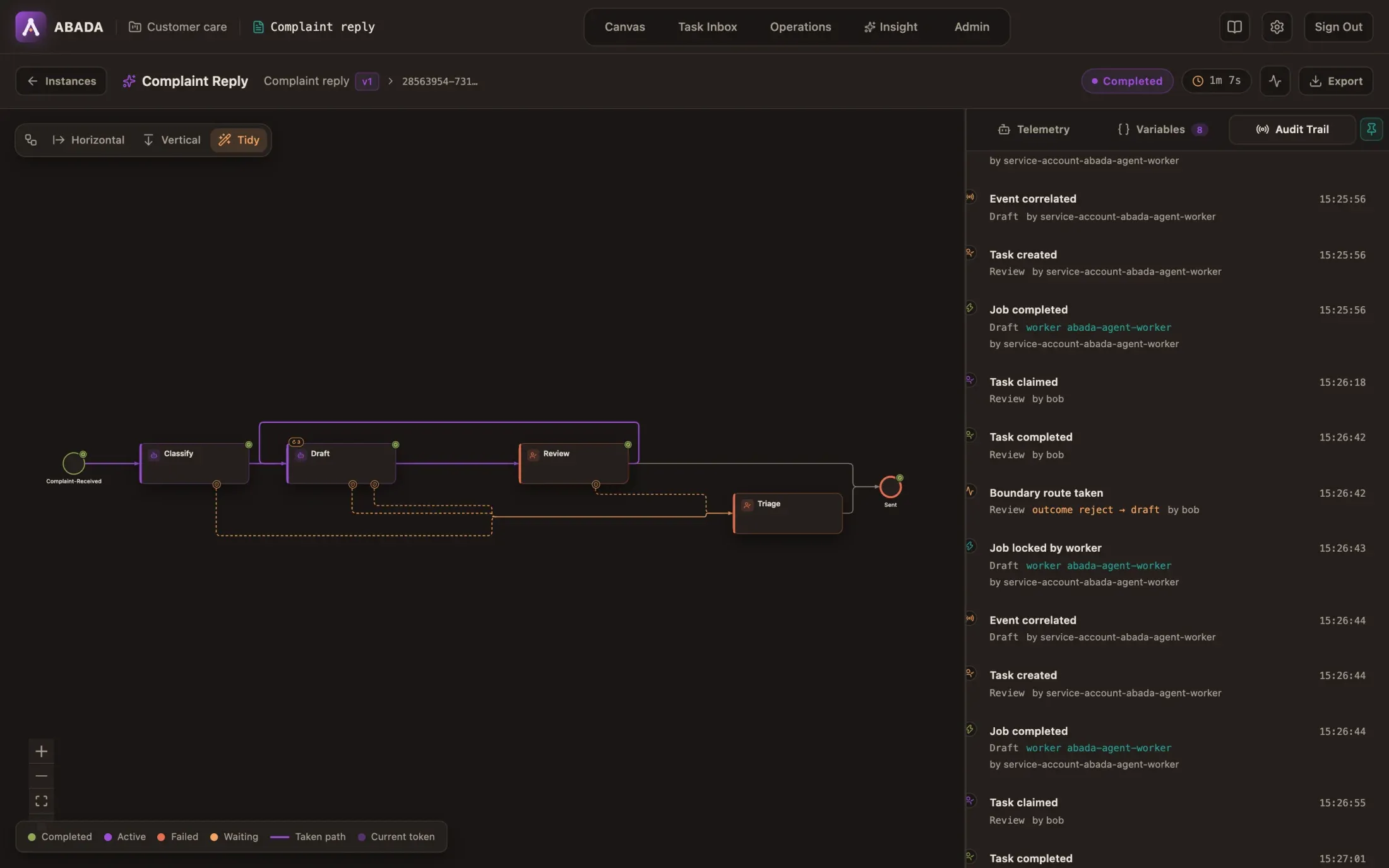
Canvas and APL YAML are one document, the engine validates while you edit, Dry Run stays local and mocked, and Deploy & Start is the durable action.
Agents are durable work
Agent nodes compile to external tasks on the worker protocol. The engine never invokes a model inside a workflow transaction.
Agents act under policy
Agents call the tools of a governed MCP tool server: reads run freely,
writes are journaled before they run, and an approval-required call waits
for a person. A crash never repeats a write blindly. New in 1.1.0-rc.2.
Processes compose
A step can call another process, and an agent can delegate a sub-case to
one, with only declared outputs coming back and lineage linking every
child. New in 1.1.0-rc.2.
Optimization is governed
The Insight Engine turns terminal facts into validated APL proposals that reach production only through explicit human review. No auto-apply.
Abada runs business processes in which AI does real work under rules you can audit:
abada.io/v1 YAML as a
diagram, and the engine compiles it directly into the executable graph.
BPMN 2.0 files import and run on the same engine, extended with Abada’s
agent and review steps.These guides describe the current dev tree.
1.1.0-rc.2 is the current evaluation release candidate (milestone
M3, agents that act): tool servers and tool policies, tool approvals, the
step journal and crash-safe writes, agent limits, evidence and cost, routing
agents, call-process and agent delegation, live instance updates and the
step inspector. See the
release notes.1.1.0-rc.1 (milestone M2, real process shapes): bounded loops, error
and timeout routes, enforced service levels, model fallback, review outcomes
with a required comment and incidents you can retry from Studio.1.0.0-rc.8 remains available. PostgreSQL is the source of truth, API v1
and worker protocol v1 are frozen, and native APL and the BPMN subset are
certified runtime surfaces.The authoritative gates live in the roadmap and contracts.